Today at the lab we dissected rockfish. A lot of them! 112! Whew! Most were females with eggs or larvae. We collect rockfish to assess female body condition and reproductive patterns in order to better understand how changing environmental conditions with climate change will influence reproductive success.
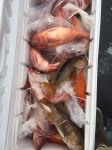
Today’s haul was caught at Cordell Bank, an isolated seamount, located about 25 miles off the coast of Pt. Reyes in central California. Ily, a researcher at NOAA/UCSC, took these photos from the collecting trip. Calm seas and lots of fish in the cooler!


At the lab, we had a crew of 11 dissecting fish, weighing tissues and collecting egg samples. This is the fun and gory part of the job!

Each fish is measured, then our team starts on dissections to carefully extract the gonads, liver, a tissue sample and otoliths (ear bones to age the fish). Fish “guts” are what we’re most interested in! Check out this massive female Bocaccio with a stomach full of Shortbelly Rockfish. Yes, some rockfish eat other rockfish!


Next, it’s all about the ‘nads, the gonads that is! We carefully dissect and weigh the ovaries, then collect the eggs and larvae to estimate how many eggs each fish produced this year. The eggs are preserved and counted by hard-working staff and interns later on. A female rockfish can produce anywhere from 12,000 to over 2 million larvae a year depending on their size and the species!


And lastly, what a cutie?! (At least for us a-fish-ionados!) A portrait of the aptly named, Yelloweye Rockfish, taken by the artistically-talented, Neosha Kashef.

 Sabrina G. Beyer