Cryptic species are two species that look very similar, but are genetically distinct and don’t breed with each other (for the most part). They often have different life history traits, such as differences in habitat (where they live), prey items (what they eat) or mating behaviors even though they look similar. Within the rockfishes, there are a couple of cryptic species pairs that look so similar that they have fooled researchers into thinking the pairs were single species! These species likely evolved millions of years ago, but only with modern genetics can we identify them as separate species!
An example of a cryptic species pair is the Vermilion (Sebastes miniatus), and more recently identified Sunset (Sebastes crocotulus) rockfish. This cryptic species pair confused me this entire week while collecting fish with NOAA partners in the Monterey Bay in central California, and with the Moss Landing Marine Labs crew to the south, in the Santa Barbara channel.
In central California, the majority of the fish that we catch are Vermilion rockfish. They are bright red, beautiful and tasty to eat! Here is one we caught this week in Monterey Bay.


The Sunset rockfish are found in deeper waters in southern California, south of Pt. Conception. Vermilion rockfish are also found in southern California, but in shallower waters.
A genetic study found that most fish caught in less than 100m (~330ft) are Vermilion rockfish and those caught deeper are Sunset rockfish. Unfortunately, we were fishing right around 350ft, where the two species intermix! When we fished deeper in 500-600ft, we found mostly the fish on the right, which we think is the Sunset species. When we fished shallower, we found a couple of the fish on the left, which could be an orange color-morph of the Vermilion, or potentially just another Sunset. But honestly, these cryptic species have me beat!
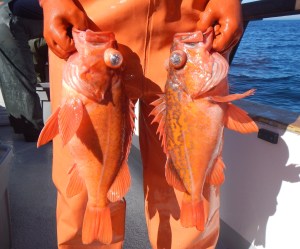
The Sunset rockfish have yet to be formally described, so the only published distinguishing characteristics are slightly smaller eyes, smaller caudal depth (the tail region) and found in deeper habitats (Hyde et al. 2008). Although the two fish above look to have different coloration patterns, coloration has not been confirmed as a distinguishing characteristic and they could in fact both be Sunset rockfish!
To make matters more complicated, here’s an underwater photo of the two species from the genetic study with Vermilion on top and Sunset on the bottom. Confused yet??
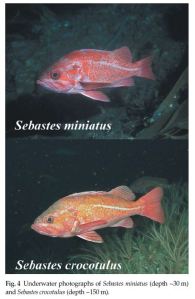
That’s ok, I am too! So why does this matter? Well, each species has its own life history traits from what they eat, to how they grow, to when they mature and how they reproduce. For management, we would like to know how these differences affect population growth and fisheries.
We still have a lot to learn about this cryptic species pair!
 Sabrina G. Beyer